
Social media is oft-maligned for its effects on tourism, but it can also be a great mechanism for discovery. So it was for the Verzasca valley – despite claiming the Contra Dam as one of my Albanian Connection checkpoints, I remained oblivious to the beauty of the river whose waters it holds back. When (a year later) Scarlett found a reel of the BoBosco trail, I realised how close I had already been – and that via my Lupine racing experience I already knew how to visit by public transport.
It is hard to imagine that anyone would need encouragement for a woodland stroll in such an attractive part of the world, but apparently small children aren’t hiking fans, and Boccia al Bosco was a local father’s solution. Boccia is the local flavour of boules (although Ticino is a Swiss canton, it’s the Italian-speaking part of the country), and BoBosco is comprised of super-sized marble runs scattered through the valley. The wooden boccia balls – like the course itself, made from local chestnut – can be rolled, cranked, winched, floated, or otherwise manoeuvred through the various stations.
PostBus 321 is the only way to access the valley without a car, and having positioned ourselves in Locarno the previous day, we therefore travelled the full length of the route, arriving in Sonogno after an hour and a quarter. I’m not generally fan of such long bus rides, but the scenery on this one is hard to beat, and it gave us a sneak preview of the terrain we’d be exploring at a more leisurely pace for the rest of the day. (It’s worth noting that the buses are few and infrequent, the last Locarno departure setting off just after 10am. They’re also popular: had we not joined the 9am service at the first stop, we’d have been standing!)
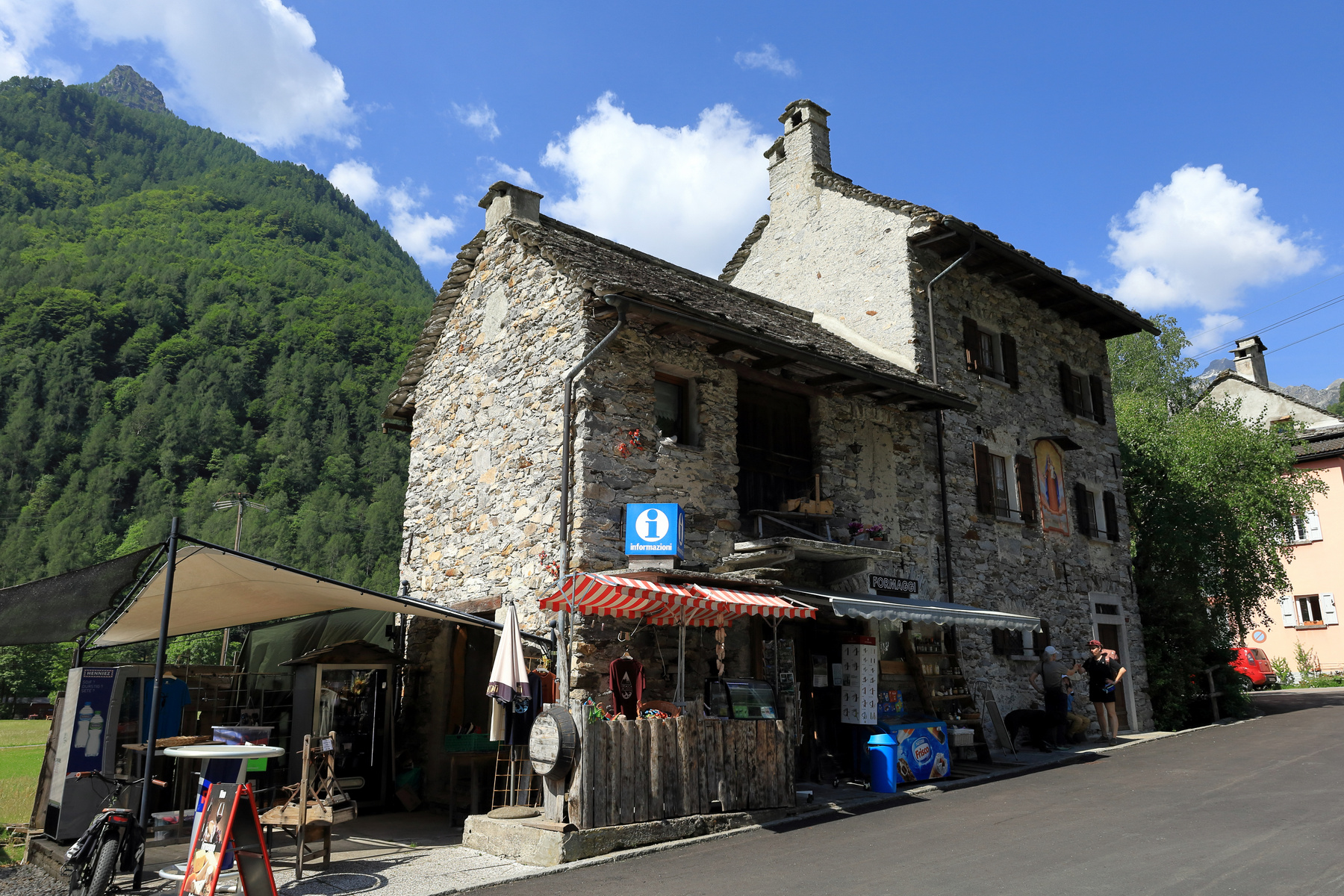
Sonogno is a charming collection of stone-and-slate buildings, one of which serves as a shop and tourist information point. This is where we purchased our boccia – the CHF 9 price contributes to the upkeep of the course. The start of the trail doesn’t seem to be signposted from the village, but head south-west to the winter sports centre and you’ll find the first station in a playground. This one was twin-tracked, so we were able to race our ball against another (rather younger!) participant’s.
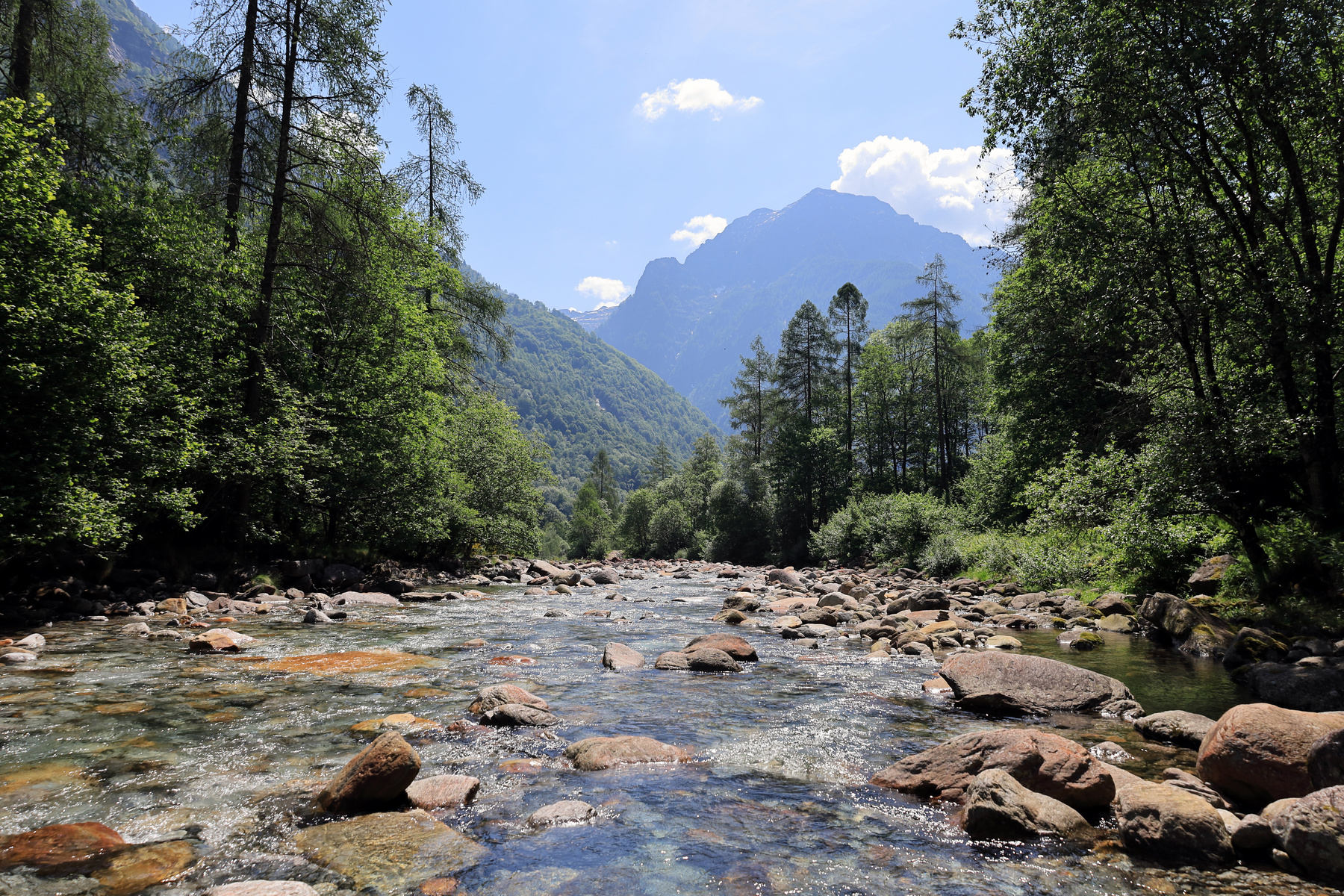
From the park a bridge traverses a small waterfall – not yet the Verzasca, but a tributary, the Redorta – and leads you into woodland, the start of the trail proper. Walking down-valley means that the scenery becomes ever more striking as you progress: the river broadening, its bed littered with larger and larger boulders that form deeper pools. At one such spot we stopped for a picnic, and to wade knee-deep into the cooling waters – a welcome respite as temperatures climbed. The path also opens up; in places trading the cover of trees for meadowland, dotted with farmhouses whose state of repair ranges from rustic to ramshackle.
And, of course, along the way are the BoBosco installations. We were really impressed by their variety and inventiveness. Gravity doesn’t do all the work, with several stations being interactive: we lifted our boccia by archimedes screw, a cable-drawn elevator, and giant wooden levers. At some stops they were full games – a tilt table, a bowling lane – whilst one puzzling contraption was straight from the crystal maze, a series of seesaws connected at random to pull-chords. A couple were a bit too ambitious, the ball bouncing off the track entirely – watch out at the second station, where ours nearly fell in the river twice! But this added to the charm – carved out of wood and stone, it’s organic and analogue, rather than machined precision.
The route ends as it begins – in a village play park by a bridge. Gerra is even smaller than Sonogno, but thanks to a Boccia vending machine you could start here and walk north. In fact, this seems to be the intended direction, given the numbering of the stations on the map.
There is also a second trail, offering another 13 stations between Brione and Lavertezzo: a slightly longer distance of 3½ miles. We had originally imagined through-hiking both, plus the 2½ miles from Gerra to Brione separating them. The official suggestion is to tackle the trails over two days, and having now tried one, I’d have to agree. The total distance would be reasonable if all we were trying to do was rack up the step count, but to properly enjoy the route our pace took a serious hit – we completed less than a mile an hour!
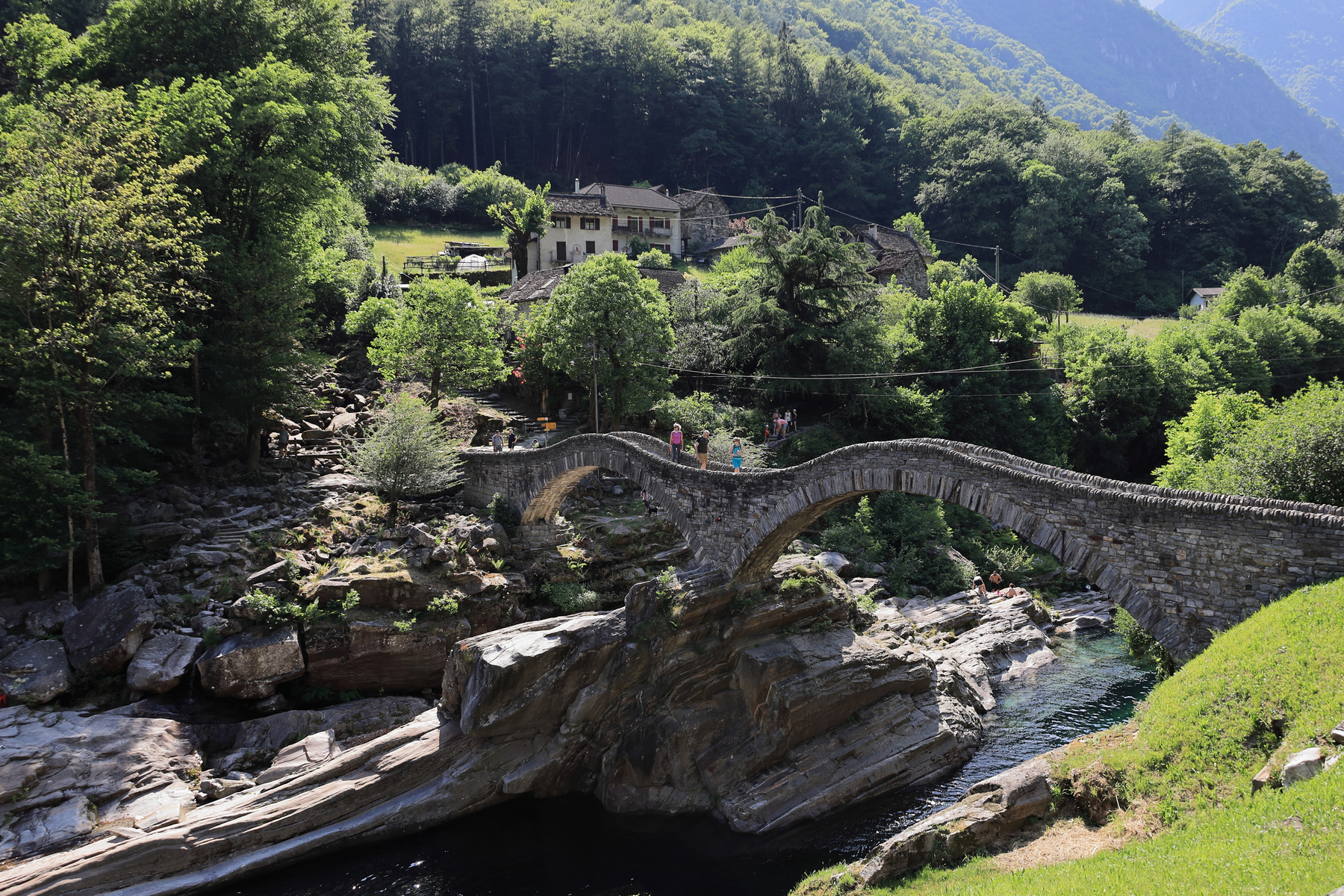
Trail two, then, will have to wait for a return visit, but a brief ride on a conveniently-timed bus allowed us to spend some time at its endpoint, Lavertezzo. The village is an attraction in its own right: by this point the river is deep enough not just for swimming, but diving. The bravest leap not from the rocks, but the medieval Ponte dei Salti – literally, “jump bridge” – some 50ft above the water. That requires far more bravery than I could muster – just crossing the bridge is an experience, as its walls are less than waist high – but I did enjoy scrambling around in the gorge.
Rather than rushing for the next bus, we spent two hours here, having found a small shop selling ice creams, and a picnic area where we could relax out of direct sun. If you try either BoBosco trail, I’d definitely budget for some time in Lavertezzo too. It was pretty busy by mid-afternoon, so perhaps it makes sense to start there in the morning before the crowds arrive, then hike up-river to Brione. Hopefully I can report back on just such an itinerary in a future post!