“Meet me at Lake Vättern, where the ancient stags dash like the winds”
Scarlett and I had spent several months unravelling the mysteries of The Emerald Flame, a “narrative puzzle adventure” whose story plays out across Europe. I’d highly recommend it to anyone who enjoys board games or escape rooms, and I hope you’ll forgive this minor spoiler: a post-game epilogue hides one final message, which we deciphered to the above. I doubt the creators, Post Curious, expected anyone to take the instruction literally – certainly, it isn’t part of the game! But once we realised the lake is in Sweden, which we already hoped to include on our Baltic Brutal itinerary, the idea of visiting proved irresistible.
But where precisely? Vättern is vast, the fourth largest lake in the EU, with plenty of settlements along its shoreline. To decide, we looked to the second half of the message, in search of ancient stags. This proved a fascinating thread to pull upon, for Sweden turns out to have a rich store of prehistoric rock carvings. A blog post pointed us towards Hästholmen on the east of the lake – although it was vague on details of where precisely to find the petroglyphs, that just felt like another puzzle to solve!
The start line briefing confirmed that a “Scandi detour” was a possible path to Tallinn, and my early calculations were that if we pushed quickly through mainland Europe, we could afford to slow down for Sweden, Finland and Estonia. We’d much rather cross the line after a week of sightseeing than three days spent purely on public transport; pausing the race entirely to make a side trip to San Marino was one of my highlights from last year’s event. So – despite a bit of time pressure from a ferry booking out of Stockholm – our plan for a detour within a detour was set.
The closest you can get to Hästholmen by rail is Mjölby, which on the fastest direct trains can be reached from Malmö or Stockholm in about two and a half hours. Our route took just over three, despite a pair of connections. From there we switched to buses – ÖstgötaTrafiken line 680 takes you all the way to Hästholmen. (tickets are easily purchased through their app, which has timetables and maps; although charged in Swedish Kroner, the one way fare for two people came out to a satisfying £9.99). There was plenty of space, USB A and C charging sockets, and pleasant rural scenes as we trundled past harvest-ready fields. We even arrived ten minutes early.
Hästholmen’s carvings can be found on a rocky outcrop in fields to the south of the bus stop: cut through the minigolf course, cross Hamngatan, and follow signs for the Hällristning along the footpath.
The most numerous features here are cup marks – close to a hundred of these small indentations pockmark the surface. Being several thousand years old, their exact purpose has been lost to time – more recent folklore identifies them as älvkvarnar – elf mills – due to a belief that elves ground flour in them! But it is suspected that they had ritual significance, possibly for sacrifices or offerings to the gods.
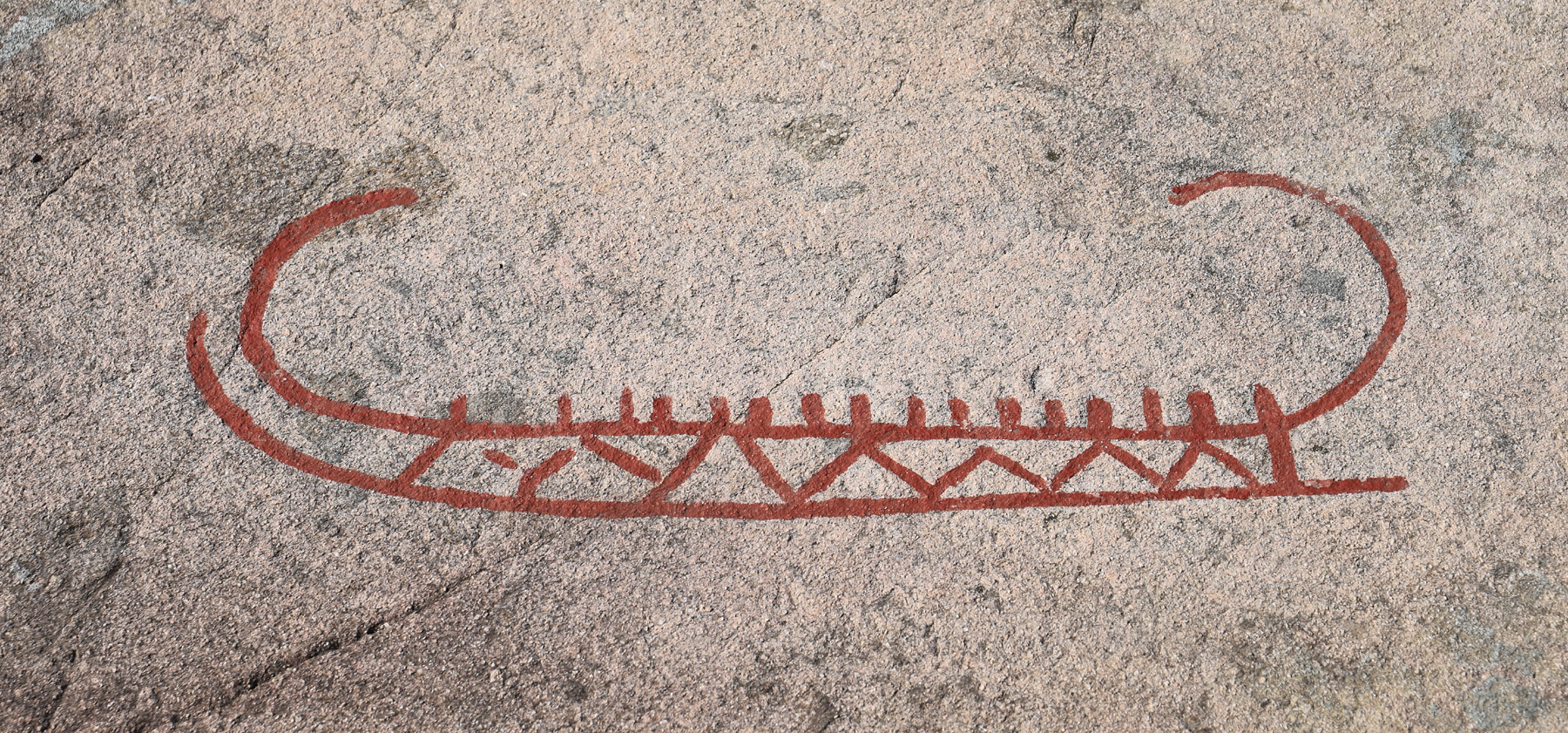
Many of these cups are subtle, but more prominent are nearby pieces of figurative art – most commonly of ships, but axes and various animals also appear. There is no rhyme or reason to their positioning, and we enjoyed scampering around looking for different examples.

Alas, it seems our stags may actually be horses – these would have been a rarity in bronze age Scandinavia, and hence a symbol of status worthy of recording. They also had divine significance: the sun was worshipped, and was believed to be pulled across the sky by a pair of horses.
Whatever the true meaning of the carvings, it’s a magical place. From the rock face we caught our first glimpse of Vättern, the tumult of its waves echoed by the rustling and swaying of the crops surrounding us. The lake is home to – or at least a migration site for – geese, and flocks of them flew across the fields as low as head-height, struggling in the heavy crosswinds. Eventually we followed the birds down to the harbour – whilst they sensibly took shelter amongst moored boats, we climbed to the lighthouse for the best – but breeziest – views of the lake.
The Vätterhästen cafe and restaurant had proved a convenient pit-stop on arrival – with free bathrooms, water and even tea – so we called back in for a late lunch before the next bus out. These are less than hourly, but that infrequency gave us enough time for a second attraction en route: Rök.

Outside the village church can be found the Rökstenen – an eight foot tall, four tonne slab of granite bearing almost 800 carved characters. This is the longest runic inscription in stone and – as it dates back to the 9th century – is also considered to be the oldest surviving piece of Swedish literature. Its purpose is debated – most likely a tribute from a father to his dead son, it also includes references to mythological characters. Interpretation is made harder by the fact that several runic alphabets are used, and it may have been a deliberate puzzle, as the message had also been enciphered.
Sadly the open-air museum offered clues only to those who can read Swedish – or runes! But this was still a striking object to find sitting around in a remote part of the countryside. For me that that’s a great part of Lupine’s events, or overlanding in general – the chance to encounter interesting things along the way that you might otherwise might never even have heard of, let alone visited. Hästholmen, Rök, and our slow travel through Sweden were a definite highlight of our race across Europe. But another was soon to follow…
Update, November 2025: For my birthday Scarlett got me another Post Curious title, Threads of Fate. On opening the first set of puzzles, we were immediately presented with a series of tasks related to runestones – with the Rök stone taking centre stage in the artwork. So unbeknownst to us, this trip was doubly-linked to these fascinating games.